
Railway Exams in India (RRB) – Complete Guide to NTPC, Group D, ALP & JE
Introduction to Railway Exams in India
Railway exams are one of the most popular government job examinations in India. Conducted by the Railway Recruitment Board (RRB) and Railway Recruitment Cell (RRC), these exams recruit candidates for various technical and non-technical posts in Indian Railways. Railway jobs are known for stability, structured promotion system, attractive salary, allowances, and long-term career growth.
Every year, lakhs of aspirants apply for RRB exams such as NTPC, Group D, ALP, Technician, and Junior Engineer (JE). Due to high competition, candidates must prepare strategically with strong basics, consistent practice, and regular mock tests.
Railway Recruitment Conducting Bodies
Railway Recruitment Board (RRB)
RRB conducts major examinations like NTPC, ALP, Technician, and Junior Engineer. It handles Computer-Based Tests (CBT), skill tests, aptitude tests, and final merit preparation.
Railway Recruitment Cell (RRC)
RRC primarily manages Group D recruitment and other regional railway vacancies. It conducts CBT, Physical Efficiency Test (PET), and document verification.
Major Railway Exams
| Exam Name | Level | Posts |
|---|---|---|
| RRB NTPC | Graduate & 12th Level | Clerk, Goods Guard, Station Master |
| RRB Group D | 10th/ITI Level | Track Maintainer, Helper |
| RRB ALP | Technical | Assistant Loco Pilot |
| RRB JE | Diploma/Degree | Junior Engineer |
Railway Exam Selection Process
NTPC
- CBT 1
- CBT 2
- Typing Skill Test / CBAT
- Document Verification
- Medical Test
Group D
- CBT
- Physical Efficiency Test (PET)
- Document Verification
- Medical Test
ALP / JE
- CBT 1
- CBT 2
- Aptitude/Technical Test
- Document Verification
- Medical Test
Railway Exam Eligibility Criteria
| Exam | Qualification | Age Limit |
|---|---|---|
| NTPC | 12th / Graduation | 18–30 Years |
| Group D | 10th / ITI | 18–33 Years |
| ALP | 10th + ITI / Diploma | 18–30 Years |
| JE | Diploma / Degree | 18–33 Years |
Age relaxation applies as per government norms.
Exam Pattern & Marking Scheme
Most railway exams are conducted in Computer-Based Test (CBT) mode.
- Correct Answer: +1 Mark
- Wrong Answer: -1/3 Mark (Negative Marking)
- Unattempted: 0 Marks
Railway Exam Syllabus (Section-Wise)
Mathematics
- Number System
- Percentage
- Profit & Loss
- Time & Work
- Time, Speed & Distance
- Ratio & Proportion
- Simple & Compound Interest
- Geometry & Mensuration
- Data Interpretation
Reasoning
- Coding-Decoding
- Series
- Analogy
- Syllogism
- Blood Relations
- Puzzles
- Direction Test
- Venn Diagram
General Awareness
- Current Affairs
- History
- Geography
- Polity
- Economy
- Static GK
- Government Schemes
General Science
- Physics (Class 10 Level)
- Chemistry (Class 10 Level)
- Biology (Class 10 Level)
Physical Efficiency Test (PET) – Group D
| Category | Standards |
|---|---|
| Male | Lift 35kg (100m) & Run 1000m in 4min 15sec |
| Female | Lift 20kg (100m) & Run 1000m in 5min 40sec |
How to Prepare for Railway Exams
- Understand the syllabus and exam pattern clearly.
- Strengthen mathematics and reasoning basics.
- Revise Class 10 science concepts.
- Follow daily current affairs.
- Practice topic-wise questions regularly.
- Take weekly sectional tests and full-length mock tests.
- Analyze previous year papers.
- Revise formulas and short notes regularly.
Conclusion
Railway exams offer a stable and rewarding career in Indian Railways. With proper planning, disciplined study, continuous practice, and mock test analysis, candidates can successfully crack RRB exams. A structured preparation strategy combined with regular revision and performance tracking significantly increases the chances of selection.
Location
EMGC Coaching in Vasai
2nd Floor, Milap Building, Vasai Station Rd, opp. State Bank of India, Vishal Nagar, Vasai West, Vasai-Virar, Maharashtra 401202
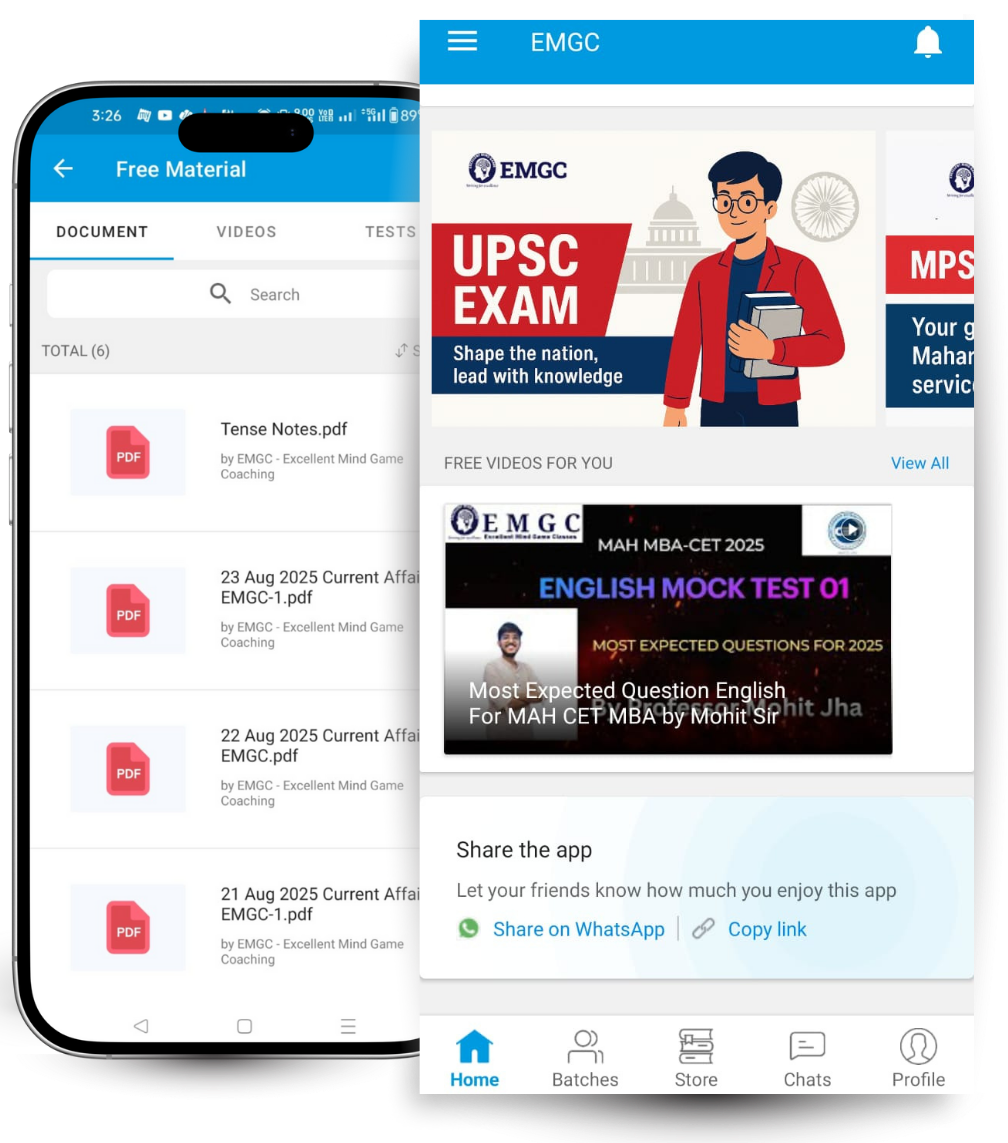
Download
the app now!